Friday, March 26, 2010

Color in Food, Part I: "Purple Ketchup?!"

Is the color of food relevant?

Many years ago, while I still lived in a small town in Mexico called Parral, Chihuahua (the "Capital of the World" as locals call it, when it's really in the middle of nothing), I came over to visit my aunt here in El Paso. We were having breakfast one morning when my aunt placed a purple bottle on the table. I asked my cousin what that was, feeling silly of my ignorance of "American food", and he said: "It's ketchup, we have green too!", while he poured some of it on his food.

Maybe it was because I came from somewhere where things like that didn't exist, but I just felt squeamish of eating purple ketchup and decided to pass and eat the regular kind.

Now I come to the conclusion that the color of a food has a great impact on whether we choose to eat it or not. I feel like our brain relates the color of the with the food taste of it. We've come to judge whether a food tastes good or bad according to the color it has. We also have an expectation of the color a food should be, and even if it's a couple of shades lighter or darker, we question whether it's good or not.

It's not casual that nowadays our foods are filled with artificial colorings. Color appeals to the appetite. For example: Maraschino cherries are dyed an obviously artificial looking red. But look just how cute it looks on our sundae. I bet if it wasn't a bright red, we would probably push it aside because we would assume that, since it has a dull color, the flavor will be dull as well.


---
As I was researching for this post, I found that Heinz's weird ketchup didn't have much demand, and was discontinued after a few years. Indeed, ketchup should look red.

Wednesday, March 24, 2010

Vestigial Traits: Appendix

Some species display traits that have seemingly lost all or most of their original function in a species through evolution. A great example is the appendix in humans.

The vermiform appendage—in which some recent medical writers have vainly endeavoured to find a utility—is the shrunken remainder of a large and normal intestine of a remote ancestor. This interpretation would stand even if it were found to have a certain use in the human body. Vestigial organs are sometimes pressed into a secondary use when their original function has been lost.

One potential ancestral purpose put forth by Charles Darwin was that the appendix was used for digesting leaves as primates. It may be a vestigial organ of ancient humans that has degraded down to nearly nothing over the course of evolution. Evidence can be seen in herbivorous animals such as the koala.
The cecum of the koala is very long, enabling it to host bacteria specific for cellulose breakdown. Human ancestors may have also relied upon this system and lived on a diet rich in foliage. As people began to eat more easily digested foods, they became less reliant on cellulose-rich plants for energy. The cecum became less necessary for digestion and mutations that previously had been deleterious were no longer selected against. These alleles became more frequent and the cecum continued to shrink. After thousands of years, the once-necessary cecum has degraded to what we see today, with the appendix. On the other hand, evolutionary theorists have suggested that natural selection selects for larger appendices because smaller and thinner appendices would be more susceptible to inflammation and disease.

Monday, March 22, 2010

Evolution: Divergence, Parallelism, and Convergence

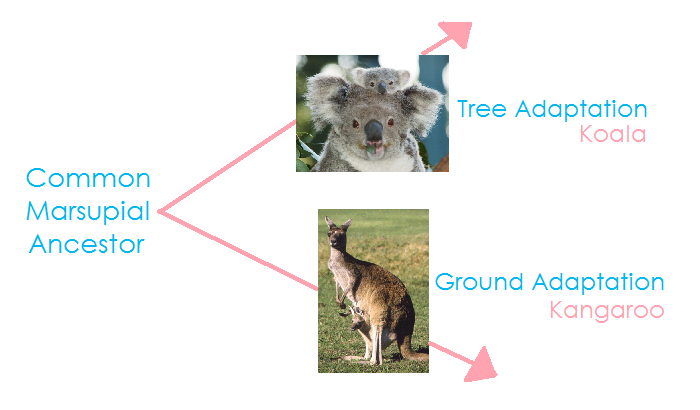
We are covering evolution, so I decided to dig out my Antrhopology notes from last semester and create some diagrams to portray the differences between divergence, parallelism, and convergence. Click on the pictures for full size!

Divergence
Related species that evolve differently as they adapt to different environments.

Parallelism
Relates species that evolve similarly as they adapt to similar environments.

Convergence
Unrelated species that evolve similarly as they adapt to similar environments.

New Species of Cockroach

Two students from Trinity High School in New York City, Brenda Tan and Matt Cost, made an interesting discovery.
"Ew I'm so gross, but everyone loves me... ♥"

These student were working on a project focused on testing the DNA of over 200 things. They found interesting things: mislabeled dairy and caviar, duster feather from an ostrich, surprisingly pure-beef hot dogs, etc. But they also discovered a new species of cockroach.

What looked like a regular cockroach didn't get a DNA match from the
Barcode of Life Database and GenBank. Professor Mark Stoeckle agreed. "Closely-related species don't differ by more than one percent," he said, "while this cockroach is four-percent different. This suggests it is a new species of cockroach."

---
Why do I keep writing about cockroaches?...

Monday, March 1, 2010

Max and China: A Punnett Square

Meet Max.
We got him when he was just a couple of weeks old, almost 10 years ago.

Meet China.
She belongs to the neighbors and has been Max's girlfriend for the past 6 years. We do not let Max out without a chain (because he runs away for fun), but the neighbors do let China out. They see each other usually on the afternoon when we chain Max in the front yard so he has a change of view (how spoiled!).

A a couple of years ago, China managed to sneak into our backyard and ended up carrying Max's offspring. Four puppies were born, and they looked something like this:
Yay for Photoshop cloned puppies!

Let's assume that the dominant allele for black coat is "B", and the recessive allele for the light beige coat is "b". Looking at Max's phenotype, we can deduce that his genotype is homozygous recessive, bb. But in China's case, her phenotype doesn't make her genotype as obvious.
China can be either homozygous dominant, BB, or heterozygous, Bb. Let's find out which is the correct genotype:
If China's genotype was homozygous dominant, BB, there is no way a puppy with light beige coat could be born. All the puppies would be heterozygous: black, carrying the recessive allele for beige coat.
Now we can see that the only way a puppy would have beige coat would be if China was heterozygous.

Friday, February 19, 2010

Conjoined Twins: What went wrong?

My cousins are identical twins. I actually wasn't able to tell them apart until they were 17.

Identical twins share more than their matchy-matchy outfits. Identical twins, or monozigotic twins, start as one fertilized egg, which later splits into two. This causes their DNA to be the same. Two exact copies.

So where does it go wrong for conjoined twins?

In the case of conjoined twins, a woman only produces a single egg, which does not fully separate after fertilization. The developing embryo starts to split into identical twins during the first few weeks after conception, but stops before the process is complete. The partially separated egg develops into a conjoined fetus.

Abigail and Brittany Hensel, born March 7, 1990 in Carver County, Minnesota, United States of America, dicephalic conjoined twins, two heads, two arms, two legs, cannot be separated.

About 40 to 60 percent of conjoined twins are still born, they die during birth. And, for some reason, female siblings seem to have a better shot at survival than their male counterparts. Although more male twins conjoin in the womb than female twins, females are three times as likely as males to be born alive. Approximately 70 percent of all conjoined twins are girls.

Surgical separation is tough one. Doctors need to see which organs the conjoined twins share. Also, the difficulty level rises depending on where the twin is joined. For example, twins joined at the sacrum at the base of the spine have a 68 percent chance of successful separation, whereas, in cases of twins with conjoined hearts at the ventricular (pumping chamber) level, there are no known survivors.

Although success rates have improved over the years, surgical separation is still rare. Since 1950, at least one twin has survived separation about 75 percent of the time.

Even after survival of surgical separation, twins will have to undergo intensive rehabilitation because of the malformation and position of their spines. The muscles in their backs are constantly being flexed and they often have a difficult time bending their backs forward and backwards and sitting up straight.


Source: http://www.umm.edu/conjoined_twins/facts.htm

Wednesday, February 17, 2010

Omnipresent Corn

I've loved corn since I was a kid. In Mexico, when you bought corn, it most of the time came with a green corn worm. My brother and I loved the worms, it was a cute pest! We probably enjoyed playing with the worm as much as eating the corn.

Corn is a staple in many families' dinners all over the world, and corn is good. It has vitamin C and A, iron, and fiber. But what about when it stops being a whole food? Oh no... we get corn syrup and high-fructose corn syrup.

Credit: Natalie Dee

Corn syrup is everywhere. Why? Because it's a cheap and serves multiple purposes: thickener, sweetener, and humectant (an ingredient that retains moisture and thus maintains a food's freshness). In the United States, cane sugar quotas raise the price of sugar; hence, domestically produced corn syrup and high-fructose corn syrup are less expensive alternatives that are often used in American-made processed and mass-produced foods, candies, soft drinks and fruit drinks to help control cost. In a nutshell, using corn syrup instead of sugar lower expenses, therefore raising company's profits. Companies main purpose is t make money, but it's sad when it takes a toll on people's health.

Corn is also fed to cows and other livestock, because (as I learned in Food, Inc.) it's cheap, fattens the animals quickly. and allows for year round beef production in colder climates. The fatter corn fed cows have a more marbled meat than grass fed cows and this is what the consumer in today’s beef market has come to know as the standard.

Though “corn finishing” produces bigger, fatter cows in less time, corn is not a natural diet for a cow. Because of this unnatural corn rich diet, some unhealthy side effects take place. Most notably, a higher incidence of E. coli O157:H7 occurs in corn fed beef than in grass fed beef. In 1998, a Cornell University study revealed that cows fed on a natural grass diet had at least 80% less E. coli O157:H7 than grain fed cows.


http://www.nbafoodadvocate.com/corn-fed-cattle-bigger-cows-bigger-e-coli-threat-more-foodborne-illness-1177